Email systems, Mamo, 2026
Mamo’s Email Studio, an email builder on React Email
Mamo’s transactional emails, the receipts, verification codes and card and dispute notices, were built one at a time in Stripo, and nothing kept them consistent. In 2026 I moved them onto an email design system built on React Email: 16 components, and an editor where a teammate assembles an email from those components and the export is safe for real inboxes.
- Stack
- My part
Why not keep Stripo
Stripo is a visual editor, and every email in it was its own one-off: styles copied from the last template and changed by hand. 89 templates had grown that way. There was no way to change a button once and have every email follow, and what Stripo showed wasn’t always what arrived. Its export carried its own fallback fonts, so some clients rendered our emails in Roboto.
The goal was an email design system in code, with an editor on top that teammates who don’t write code could use without breaking the design.
Wrap the editor, don’t write one
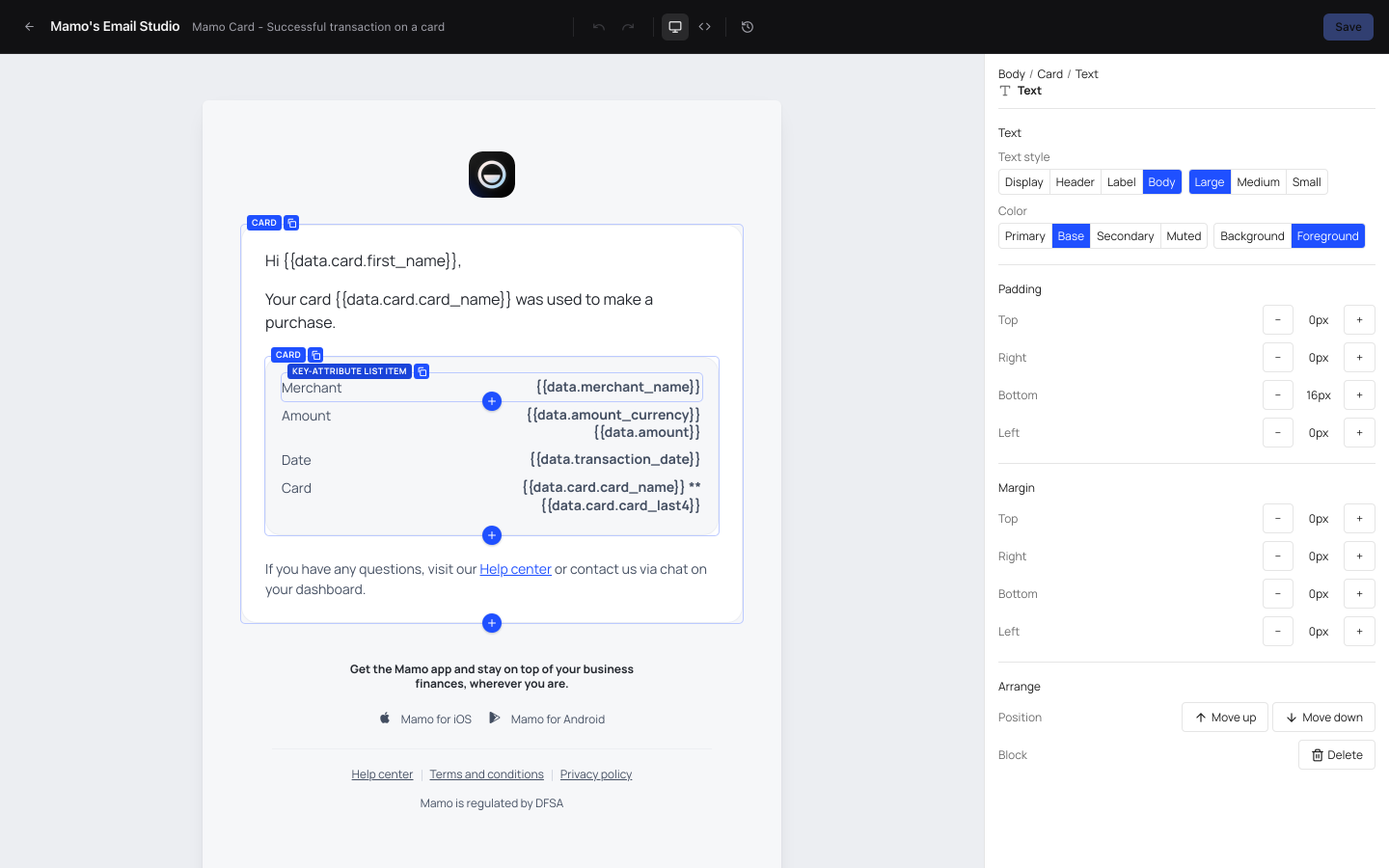
A rich-text editor written from scratch is months of work. React Email 6 shipped @react-email/editor, Resend’s own editor built on TipTap and ProseMirror, and it serializes straight to React Email components. So I wrapped it: each Mamo component became an editor block, from the header and cards to key-attribute lists, tables, buttons and footers, with closed choices instead of free styling. A text block offers the design system’s type styles and colors, not a font picker. Spacing is steppers, and blocks whose padding belongs to the design system lock it.
What the canvas shows and what gets exported are two different things, and only the export reaches an inbox: table layouts, inline styles, no flexbox, nothing that depends on hover.
Built with Claude Code
I built the studio with Claude Code, and the split was clear. I did the thinking: the architecture, the design system’s rules, what to build next and what good looked like, and I kept suggesting the next idea. Claude Code did most of the implementing, and it was quick to catch and fix bugs once I’d pointed at where to look.
Every bug in the next section started the same way: I sent a real email to a real inbox, or pasted it into a real tool, and saw something wrong. Tracing it to the cause was work we did together.
Four bugs only a real inbox showed
The editor’s preview and Apple Mail looked right through all four of these. I ranked email clients by where Mamo’s email actually lands, from a week of SendGrid delivery data, and tested on real devices in that order. Gmail came first by a wide margin, and two of the four bugs were Gmail’s. Each fix became a standing rule for the project, so the next component can’t bring the bug back.
From my laptop to the team
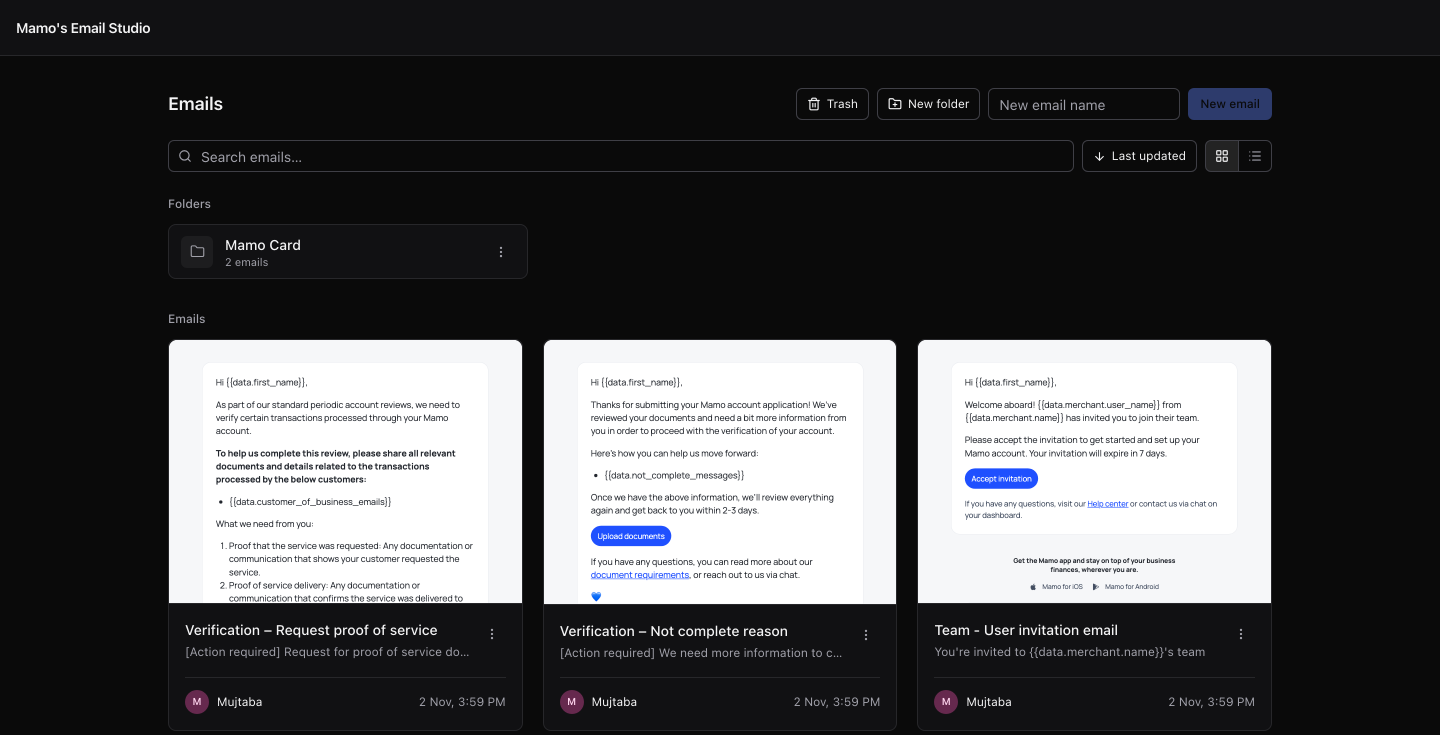
The builder started on my machine. To let anyone at Mamo work on emails, it moved to Cloud Run with Firestore, behind Google sign-in through IAP, with access given through a Google group. Templates live only in Firestore, and every save is a version with who, when and the full content, which gives history, restore, a trash and an activity log. The library got live previews, folders and a ranked word search, so “card acti” finds “Card is activated”.
Then it was slow. I compressed the build, split the editor into its own chunk, kept the library in memory, and prefetched an email when you hover or focus it. One fix nearly shipped a crash: loading the editor lazily behind Suspense made React reconnect its effects mid-load, TipTap destroyed its instance, and opening an email went blank. The fix was to render the editor only once its code has loaded.
| Moment | Before | After |
|---|---|---|
| Open the library | A 2.9 MB script, sent uncompressed, then 1.7 s for the list | Visible in about 0.4 s |
| Open an email | Fetched fresh every time | About 5 ms after the click, prefetched on hover |
| Back to the library | Everything refetched | About 30 ms, kept in memory |
What’s next
The studio doesn’t send email yet. The plan I shared with engineering: “eventually the emails created would connect to Resend and we’d send emails from the codebase instead of using SendGrid.” Before that, image uploads straight to Mamo’s asset CDN, and rendering the library’s previews on the server, so the first visit after a release is as fast as the rest.